
Why Islamic Finance Builds Economies and Interest-Based Systems Don’t
“At a time when debt, speculation, and inequality are growing across financial systems, Islamic finance offers a rare alternative: a system built not just for return, but for responsibility”.
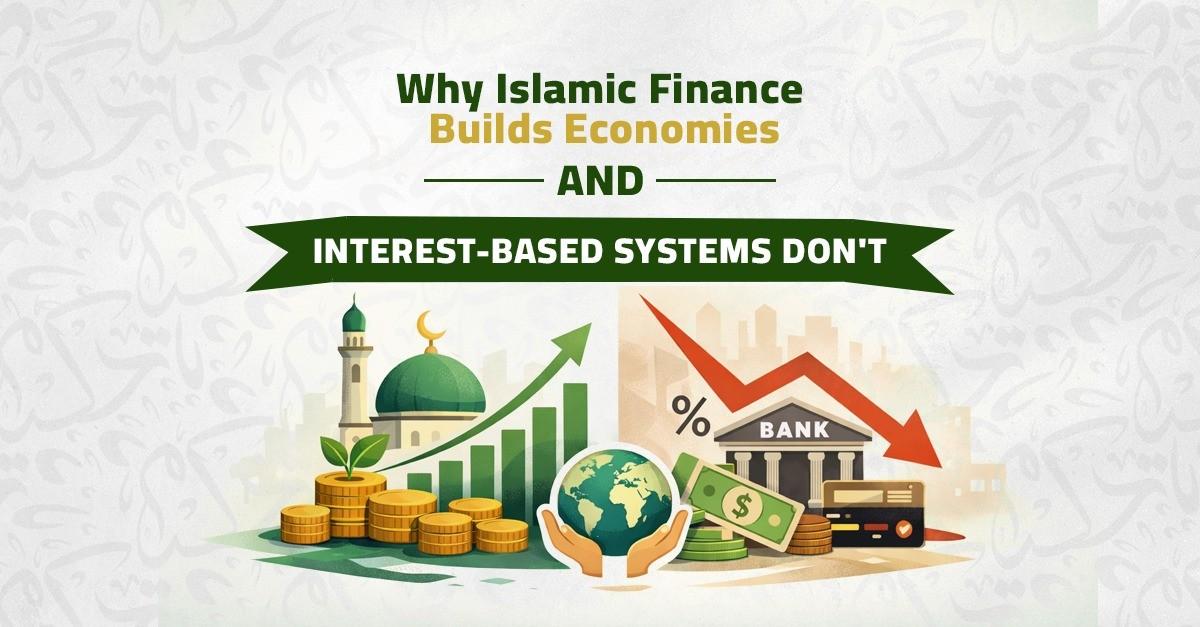
Modern finance has brought speed, convenience, and scale. But it has also created instability, inequality, and debt cycles that weigh heavily on the most vulnerable.
Islamic finance offers an alternative. It doesn’t just change how money moves; it rethinks why and for whom it moves.
Here’s why Islamic finance isn’t just religiously aligned. It is economically sustainable too.
1. Risk is Shared, Not Shifted
In conventional interest-based lending, the lender bears no risk. Whether the borrower succeeds or fails, repayment with interest is required. That burden falls entirely on the person least able to afford it.
Islamic contracts like Musharakah and Mudarabah work differently. They tie returns to responsibility. Investors bear the risk of their capital, which entitles them to the ensuing profit. This approach discourages the kind of reckless over-lending and over-borrowing that has led to financial crises around the world.
2. Money Must Be Tied to Real Trade or Services
In Islamic finance, you can only earn a return if your money is connected to something tangible: a product, a service, or a real economic activity.
This keeps money grounded in real work and real value. It also prevents the kind of artificial financial bubbles that have caused markets to collapse in the past.
3. No Profit Without Real Effort
Islamic finance does not allow wealth to grow just by passing money from one hand to another. You cannot earn simply by lending. Profit must come from trade, effort, or risk-taking.
This helps filter out speculative behavior that creates fake wealth but leaves real economic damage behind.
4. Debt is Treated as a Burden, Not a Product
In conventional microfinance, a loan becomes a product. It is packaged, sold, profited off, and scaled like any other business.
Islamic finance sees loans differently. They are a last resort, not an investment avenue. The focus stays on supporting the borrower, not squeezing value from their hardship.
5. Wealth Should Circulate, Not Concentrate
Through tools like zakat, qard-e-hasan, and the prohibition of interest, Islamic finance encourages money to flow across society. It avoids letting wealth gather only at the top.
This leads to stronger communities, more equal opportunity, and greater long-term resilience for the economy.
The Rise of Islamic Finance in Pakistan
Islamic finance is not just an idea, it is growing fast in Pakistan’s financial system.
- By March 2025, Islamic banking assets in Pakistan had crossed PKR 11.5 trillion. The sector passed the 10 trillion mark by December 2024 for the first time, showing its expanding role in the country’s financial system.
- As of December 2024, Islamic banking assets in Pakistan accounted for 20.6% of the total banking sector’s assets, while deposits captured an even larger share at 24.9%.
Final Thought
Some people see Islamic finance as strict or limiting. But at its heart, it is protective. It looks out for people. It preserves purpose. It keeps balance in economic life.
At a time when debt, speculation, and inequality are growing across financial systems, Islamic finance offers a rare alternative: a system built not just for return, but for responsibility.
